New Build or Resale in Edmonton: Which Is the Better First Home?
New build or resale is usually framed as new-and-expensive against old-and-cheap. Edmonton's actual market does not cooperate with that framing, and the reason is instructive: the oldest homes in the city are not the cheapest, because they sit on the most central land.
The short answer
New builds cost more up front, come with warranty coverage and few immediate repairs, and may attract GST. Resale homes cost less per square foot in most of the city, come with mature neighbourhoods and established landscaping, and hand you the maintenance schedule of whatever era they were built in. Neither is better; they fail in different ways.
Key takeaways
- Price does not track age straightforwardly in Edmonton — the chart below shows pre-1960 stock sitting above the 2000s.
- New builds may attract GST, which resale homes generally do not. Confirm whether a quoted price includes it.
- New homes in Alberta carry mandatory warranty coverage; resale homes carry none.
- New communities are still being built around you — construction, unfinished amenities and no mature trees for years.
- Resale means inheriting a maintenance schedule. What matters is where the roof, furnace and windows are in their life.
Who this guide is for
Edmonton buyers weighing a new build against an existing home. Market figures refresh with our listing feed; warranty and tax rules are provincial and federal respectively.
What each era actually costs
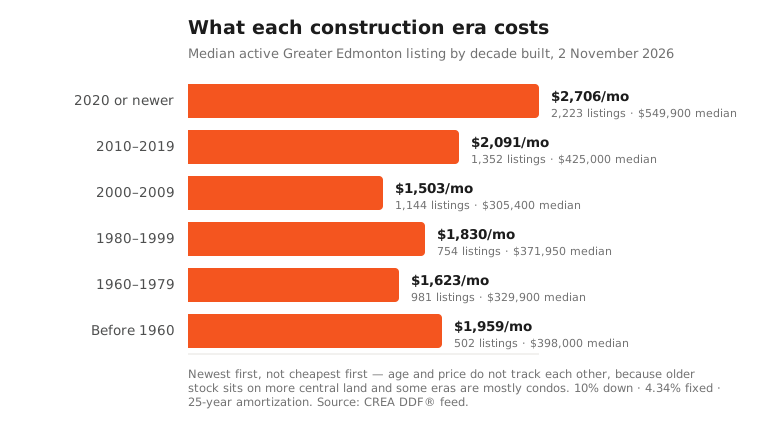
The newest homes are the most expensive, as expected. But the oldest group is not the cheapest — it sits above two more recent eras, because pre-1960 housing in Edmonton occupies mature central land, and land is what you are paying for. The cheapest eras are the ones with the highest share of condos and the most peripheral locations.
This is why "old is cheap" is a poor way to search. What you are buying is location, condition and type, and the year built is a proxy for all three at once.
The case for a new build
- Warranty. New homes in Alberta carry mandatory coverage, with defined periods for different elements. That is real protection a resale home does not have.
- Nothing immediately needs replacing. The roof, furnace and windows all start their life with you.
- Modern efficiency and layout — better insulation, and floor plans built for how people live now.
- Some choice of finishes, if you buy early enough in the build.
Against that: you may pay GST, the price per square foot is higher, and the community around you is unfinished — which can mean years of construction traffic and a long wait for the promised amenities.
The case for resale
- Mature neighbourhoods. Established trees, working transit, schools with a history, shops that already exist.
- More house for the money in most of the city, particularly for square footage and lot size.
- You can see what you are buying — not a show home and a floor plan, but the actual house, in the actual light, on the actual street.
- Room to improve. A dated kitchen is a negotiating point and a project, not a defect.
Against that: no warranty, and an inherited maintenance schedule. The inspection matters more here than anywhere else.
On a resale home, ask the age of four things: roof, furnace, hot water tank and windows. Together they represent most of what can go expensively wrong in the first years, and the answer changes what the house is worth to you.
The costs that only apply to one
GST generally applies to newly built homes and generally does not to resale. Whether a builder's advertised price includes it is a question to ask directly and early — it is a large number to discover late.
Landscaping, fencing, window coverings and a deck are frequently not included in a new build and are frequently assumed to be. A resale home usually has all four.
Possession timing. A new build's completion date can move, which matters a great deal if you have given notice on a rental.
How to decide
Ask what you are optimising for. If it is certainty and low near-term maintenance, a new build earns its premium. If it is location, space and a neighbourhood that already works, resale usually wins in Edmonton — and the chart above shows the premium for the newest stock is real.
Whichever you choose, run the same total-monthly-cost comparison from step 5, and price the extras that only apply to one of them.

Ryan McCann
Ryan is an Edmonton-based REALTOR® with MaxWell Polaris and the person behind Padster. He's helped over 2,200 clients in the Edmonton area buy and sell their home.
Contact Ryan today at 780-964-8445 to talk through your next step.
Last reviewed 12 August 2026. General information for Edmonton-area buyers — not individualized financial, mortgage, legal or tax advice. Mortgage rules, government programs and market figures change; confirm current details with a licensed mortgage professional, an Alberta real-estate lawyer, or the relevant government source before making a decision. Padster is not a brokerage.
Sources
- Alberta Municipal Affairs — New home warranty in Alberta
- Canada Revenue Agency — GST/HST new housing rebate
- Construction-era medians derived from the CREA DDF® feed for Greater Edmonton, refreshed with this site.
- CMHC — Information for consumers
Your next step
Compare eras on the monthly number
New or resale, the question is what it costs you each month. Every Greater Edmonton listing here is priced that way.
Browse Edmonton homes by monthly paymentFrequently asked questions
Are new builds more expensive than resale in Edmonton?
On the median, yes — the newest stock carries the highest median payment. But age and price do not track cleanly: pre-1960 homes sit above homes from the 2000s, because older housing occupies more central land.
Do I pay GST on a new home in Alberta?
GST generally applies to newly constructed homes and generally does not to resale. Whether a builder's advertised price includes it varies, so ask directly. Rebates may apply in some circumstances.
What warranty comes with a new home in Alberta?
New homes in Alberta are covered by mandatory new home warranty, with defined coverage periods for different building elements. Ask the builder for the specific coverage and provider for your home.
Is it cheaper to buy an older home in Edmonton?
Sometimes, but not reliably — it depends far more on location and property type than on age. The chart in this article shows the pre-1960 group is not the cheapest era in the current market.
What is not included in a new build?
Commonly landscaping, fencing, window coverings and a deck, and sometimes appliances. These are frequently assumed to be included and frequently are not, so confirm in writing and budget for them.
Can a new build's possession date change?
Yes, completion dates can move. If you have given notice on a rental or arranged movers, ask what the contract says about delay and build some flexibility into your plans.