How to Save for a Down Payment in Canada Using an FHSA, RRSP and Other Programs
The down payment is usually the reason a first purchase is two years away rather than two months. The good news is that Canada has two tax-sheltered accounts built specifically for this, they can be used together, and most first-time buyers do not realise how much room they have.
The short answer
Fill an FHSA first — contributions are deductible and qualifying withdrawals are tax-free, which no other account offers. Use the Home Buyers' Plan alongside it if you already hold RRSP savings. In Alberta you also need less cash on closing than most of Canada, because the province charges no land transfer tax.
Key takeaways
- Minimum down payment is 5% on the portion up to $500,000, then 10% to $1.5 million.
- The FHSA allows $8,000 a year to a $40,000 lifetime limit — deductible going in, tax-free coming out for a qualifying home.
- The Home Buyers' Plan allows an RRSP withdrawal of up to $60,000, repayable over 15 years.
- You may use both for the same home, provided you meet each set of conditions at the time of each withdrawal.
- Open an FHSA even if you cannot fund it yet — contribution room starts when the account is opened, not when you first deposit.
How much you actually need
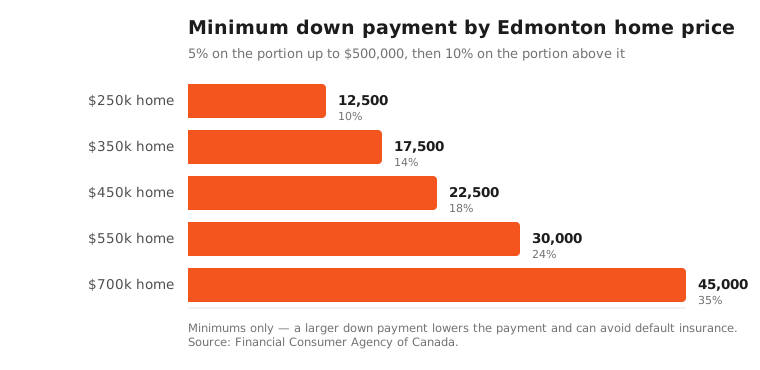
Note what happens above $500,000: the 10% rate applies only to the portion above that line, not the whole price. A $550,000 home needs $25,000 on the first $500,000 plus $5,000 on the next $50,000 — $30,000, not $55,000.
The FHSA: the first account to fill
The First Home Savings Account combines the two tax advantages that previously required choosing between an RRSP and a TFSA. Contributions are deductible from your income like an RRSP contribution, and qualifying withdrawals for a first home come out tax-free like a TFSA withdrawal — with no repayment obligation.
You get $8,000 of participation room per year, to a lifetime maximum of $40,000. The detail worth acting on today: room begins accruing when the account is opened, not when you first put money in. Opening one with a nominal deposit starts the clock.
A common ordering mistake: contributing to an RRSP specifically to withdraw it later under the Home Buyers’ Plan, while leaving FHSA room unused. The FHSA gives the same deduction without the repayment obligation. Worth confirming your own situation with a tax professional.
The Home Buyers' Plan: useful, but it is a loan to yourself
The Home Buyers' Plan lets you withdraw up to $60,000 from your RRSP for a qualifying home without immediate tax. The distinction from an FHSA matters: this is borrowed from your own retirement savings and must be repaid over 15 years. Miss a year's repayment and that amount is added to your taxable income.
Repayment does not begin immediately. Under temporary relief, the repayment period starts the fifth year after the year of a first withdrawal for first withdrawals made between 1 January 2022 and 31 December 2025.
One timing trap: RRSP contributions made within 89 days before an HBP withdrawal may not be fully deductible. If you are planning to contribute and then withdraw, that gap needs to be wider than most people assume.
FHSA and HBP compared
| FHSA | Home Buyers' Plan | |
|---|---|---|
| Limit | $8,000/year, $40,000 lifetime | $60,000 withdrawal |
| Contribution deductible? | Yes | Yes (as an RRSP contribution) |
| Withdrawal taxed? | No, if qualifying | No, if repaid on schedule |
| Must be repaid? | No | Yes, over 15 years |
| Best suited to | New savings toward a first home | RRSP savings you already hold |
They are not alternatives. The Canada Revenue Agency permits a qualifying FHSA withdrawal and an HBP withdrawal for the same home, so a buyer with both can use both.
Do not forget closing costs
A down payment is not the only cash you need. Budget separately for an Alberta real-estate lawyer, a home inspection, an appraisal if your lender requires one, and the province's Land Titles registration fees — $50 plus $5 per $5,000 of value on the transfer, and $50 plus $5 per $5,000 of the amount secured on the mortgage.
Alberta buyers do get a genuine break here: the province charges no provincial land transfer tax. On a $400,000 purchase the registration fees come to roughly $880 in total, where a land transfer tax elsewhere could be several thousand.
Who this guide is for
Anyone saving toward a first home in the Edmonton area, whether that purchase is six months away or three years. The federal accounts described here apply Canada-wide; the closing costs at the end are Alberta-specific, and they work in your favour.
"First-time buyer" has a specific meaning for each program, and the definitions are not identical between the FHSA and the Home Buyers' Plan. If you have owned before, or your spouse has, check the definition for the specific program with the Canada Revenue Agency rather than assuming.
Where else the money can come from
A gift from an immediate family member
Gifted down payments are common and generally acceptable to lenders, but they come with paperwork. Expect to provide a signed gift letter confirming the money is a gift rather than a loan, and expect the lender to trace where it came from. A gift that arrives as cash, or lands in your account days before closing without explanation, will cause problems.
Savings outside registered accounts
Perfectly usable, but the same traceability applies. Lenders typically want to see the funds in your account for a period before closing, so moving money between accounts late in the process creates work rather than saving it.
What generally will not work
Borrowed down payments — a personal loan or line of credit taken specifically to fund the purchase — are treated differently and may not be acceptable, and the payment counts against your debt ratios either way. Discuss any borrowed portion with your mortgage professional before relying on it.
How long it takes, realistically
The FHSA's $8,000 annual room shapes the timeline more than most people expect. Saving the full amount each year reaches roughly $20,000 — enough for the minimum on a $400,000 Edmonton home — in about two and a half years, before any investment growth or matching contributions from a spouse.
Two people saving separately changes the picture substantially. Each may hold their own FHSA, so a couple has $8,000 each per year and up to $40,000 each in lifetime room. That is the single biggest lever available to most first-time buyers, and it is frequently missed.
While you save, it is worth knowing what the target looks like: Edmonton homes under $1,500 a month is roughly the band a $20,000 down payment reaches.
Common mistakes to avoid
Waiting to open an FHSA until you can fund it
Room accrues from when the account opens. Waiting a year to open one costs a year of room you cannot get back.
Saving only the down payment
Closing costs are separate and real. Arriving at possession with the down payment exactly covered and nothing else is a stressful way to start.
Emptying the emergency fund
The months after possession tend to generate expenses. Keeping a reserve is not excessive caution; it is the difference between a repair being an inconvenience and being a crisis.
Assuming the minimum is the goal
A larger down payment lowers the payment and reduces or avoids mortgage default insurance. The minimum is a floor, not a target — though waiting years to reach 20% has its own costs to weigh.
Your next practical steps
- Open an FHSA, even with a small deposit — room starts when the account opens.
- Work out your target using the chart above plus closing costs.
- Check your existing RRSP balance to see whether the Home Buyers' Plan is available to you.
- Mind the 89 days rule if you intend to contribute to an RRSP before withdrawing.
- Confirm your eligibility with a qualified tax professional — first-time buyer definitions have specific conditions.

Ryan McCann
Ryan is an Edmonton-based REALTOR® with MaxWell Polaris and the person behind Padster. He's helped over 2,200 clients in the Edmonton area buy and sell their home.
Contact Ryan today at 780-964-8445 to talk through your next step.
Last reviewed 11 August 2026. General information for Edmonton-area buyers — not individualized financial, mortgage, legal or tax advice. Mortgage rules, government programs and market figures change; confirm current details with a licensed mortgage professional, an Alberta real-estate lawyer, or the relevant government source before making a decision. Padster is not a brokerage.
Sources
- Canada Revenue Agency — First Home Savings Account (FHSA)
- Canada Revenue Agency — The Home Buyers' Plan
- Canada Revenue Agency — Repaying amounts withdrawn under the HBP
- Financial Consumer Agency of Canada — How much you need for a down payment
- Government of Alberta — Land Titles fee schedule
Your next step
See what your savings target buys
Knowing the down payment is half of it. See which Edmonton homes land in your monthly range, so the target you are saving toward is a real one.
Browse Edmonton homes by monthly paymentFrequently asked questions
How much down payment do I need for a home in Alberta?
The federal minimum is 5% on the portion of the price up to $500,000 and 10% on the portion between $500,000 and $1.5 million. Above $1.5 million, 20% is required and mortgage default insurance is unavailable. On a $400,000 Edmonton home the minimum is $20,000.
Should I use an FHSA or the Home Buyers' Plan first?
For new savings, the FHSA is generally the stronger tool: contributions are deductible, qualifying withdrawals are tax-free, and nothing has to be repaid. The Home Buyers' Plan is most useful when you already hold RRSP savings. Many buyers use both — confirm your situation with a tax professional.
Can I use both an FHSA and the Home Buyers' Plan for the same home?
Yes. The Canada Revenue Agency permits a qualifying FHSA withdrawal and an RRSP Home Buyers' Plan withdrawal for the same qualifying home, provided you meet the conditions for each at the time of each withdrawal.
When do I have to repay the Home Buyers' Plan?
Over 15 years. Under temporary relief, the repayment period begins the fifth year following the year of a first withdrawal, for first withdrawals made between 1 January 2022 and 31 December 2025. A missed annual repayment is added to your taxable income for that year.
Does opening an FHSA before I have money to put in it help?
Yes. Participation room begins accruing when the account is opened rather than when you first contribute, so opening one early starts building room you can use later.
What are closing costs in Alberta?
Alberta charges no provincial land transfer tax, which is a real saving relative to several other provinces. You will still need legal fees, an inspection, possibly an appraisal, and Land Titles registration fees of $50 plus $5 per $5,000 of value on both the transfer and the mortgage.