How Much Home Can You Afford in Edmonton Based on Your Rent?

You know exactly what you pay in rent each month. That number is the most useful thing you own when working out what you could buy — but turning it into a price takes a few steps, and the honest version of the answer is lower than the one a mortgage calculator will give you.
The short answer
Your rent sets a comfortable monthly ceiling; a lender sets a maximum. Start from your rent, subtract what ownership adds — property taxes, insurance, maintenance, and condo fees where they apply — and the remainder is what can go toward a mortgage payment. That, not your maximum approval, is the number to shop with.
Key takeaways
- Your rent shows what you can pay. Lender ratios show what you may borrow. The two answer different questions and rarely produce the same number.
- Lenders apply two ratios: 39% of gross income for housing costs, and 44% for housing plus all other debt.
- You are assessed at the stress-test rate — the greater of your contract rate plus 2% or 5.25% — so approval is based on a payment higher than the one you will make.
- Ownership adds roughly 15–25% on top of a mortgage payment once taxes, insurance and maintenance are counted. Budget for it before you shop, not after.
- In Edmonton the bedroom count your budget reaches shifts sharply between $1,500 and $2,500 a month — worth knowing before you rule out a house.
Who this guide is for
Edmonton-area renters who know what they pay each month and want to translate that into a realistic price range before speaking to a lender. The federal rules here apply Canada-wide; the market figures are specific to Greater Edmonton and refresh with our listing feed.
Start with what you actually pay now
Not just rent. Add tenant insurance, parking, storage, and any utility your landlord currently covers that you would pay yourself as an owner — heat and water are the usual ones. That total is your real housing cost today, and it is the only fair baseline for comparison.
Most renters undercount here by $100 to $200 a month, which quietly makes ownership look like a bigger jump than it is.
Then subtract what ownership adds
A mortgage payment is not the cost of owning a home; it is the largest line in it. Before you translate your budget into a price, take these off the top.
| Cost | Rough monthly guide | Notes |
|---|---|---|
| Property taxes | Varies by assessed value | Billed by the City of Edmonton; commonly paid monthly alongside the mortgage |
| Home insurance | Required by your lender | Replaces tenant insurance, and costs more |
| Condo fees | Applies to condos, many townhouses | Ask what is included — heat and water sometimes are |
| Maintenance | Set something aside monthly | The line a landlord used to absorb |
| Utilities you did not pay before | Often higher in a house | More square footage, more to heat |
What remains is what can reasonably go toward principal and interest. That is the figure to put into Padster's search — and it will be lower than your rent, which is the point.
A worked example
Take a renter paying $1,900 a month, plus $25 tenant insurance and $60 for a parking stall — $1,985 all in. That is the honest starting figure, not $1,900.
Now subtract what ownership adds. Suppose property taxes work out to about $250 a month, home insurance $110, and a maintenance set-aside of $200. That is $560 off the top, leaving roughly $1,425 available for principal and interest if they want to keep their total housing cost where it is today.
At $1,425 a month on our standard assumptions, that corresponds to a home around $290,000 — noticeably less than the $400,000 a naive "my rent is $1,900" calculation would suggest. Neither number is wrong; they answer different questions. The first answers "what can I spend and feel the same as I do now." The second answers "what would consume my entire housing budget."
Many buyers decide they are comfortable spending somewhat more than they do now, and that is a legitimate choice. The point is to make it deliberately rather than discover it after possession.
Illustrative figures only. Property taxes, insurance and maintenance vary by property — confirm the actual numbers for any home you are considering.
Working the other way round? Padster searches by estimated monthly payment rather than list price, so you can put your number in directly and see what it reaches — start from what you pay now.
What a lender will separately decide
Your comfortable budget and a lender's maximum are calculated differently, and it is worth understanding both so you are not surprised in either direction.
Lenders apply two ratios. Gross Debt Service caps housing costs — principal, interest, property taxes, heat, and half of any condo fees — at 39% of gross household income. Total Debt Service caps that plus every other debt payment at 44%. A car loan does not change what a house costs, but it absolutely changes what you can borrow.
On top of that sits the stress test: federally regulated lenders must qualify you at the greater of your contract rate plus 2%, or 5.25%. You are approved against a payment larger than the one you will actually make. It is deliberately conservative, and it is why the number a calculator shows and the number a lender confirms can differ noticeably.
What each budget reaches in Edmonton
Here is the part that is hard to get from a national calculator: what these numbers actually buy in this market, today.
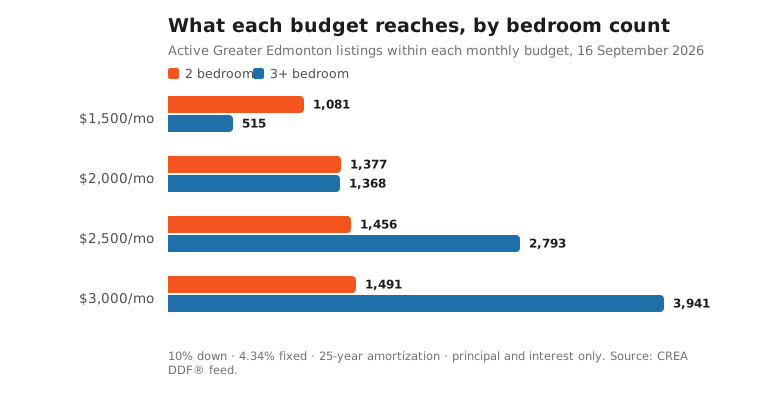
See Edmonton homes by monthly payment to run your own figure against the live feed. The pattern matters more than any single figure. At $1,500 a month, two-bedroom homes outnumber three-bedroom-plus by more than two to one. By $2,500 that has inverted — three-bedroom-plus outnumber two-bedroom by nearly two to one. If you are deciding whether a house is realistic, the answer changes sharply across a fairly narrow band of monthly budget.
Assumptions: 10% down, 4.34% fixed, 25-year amortization, principal and interest only. Excludes property taxes, condo fees, insurance, utilities and maintenance. Illustrative only — confirm the numbers for your circumstances with a licensed mortgage professional.
Questions worth asking yourself
- Is the number I am shopping with my comfortable budget, or the largest figure anyone has quoted me?
- Have I subtracted taxes, insurance and maintenance, or am I comparing rent to a mortgage payment?
- What existing debt payments will a lender count against me, and could clearing one meaningfully change my range?
- If rates were higher at renewal, would this payment still work?
Common mistakes to avoid
Shopping at your maximum approval
A pre-approval is a ceiling, not a recommendation. Shopping at the top of it leaves nothing for the costs that arrive with ownership.
Forgetting condo fees are permanent
A lower price with a high monthly fee can cost more than a higher price without one. Compare the complete monthly figure, not the list price.
Assuming the estimate is the whole payment
Every monthly figure on Padster is principal and interest. It is a consistent basis for comparing homes — not a forecast of your total cost of ownership.
Your next practical steps
- Total your real current housing cost, including insurance, parking and utilities.
- Subtract the ownership costs from the table above to find your realistic mortgage-payment budget.
- List your other debt payments — these affect what a lender will approve.
- Search by that monthly figure rather than by price, and see what it reaches.
- Confirm the range with a licensed mortgage professional before you start viewing seriously.

Ryan McCann
Ryan is an Edmonton-based REALTOR® with MaxWell Polaris and the person behind Padster. He's helped over 2,200 clients in the Edmonton area buy and sell their home.
Contact Ryan today at 780-964-8445 to talk through your next step.
Last reviewed 11 August 2026. General information for Edmonton-area buyers — not individualized financial, mortgage, legal or tax advice. Mortgage rules, government programs and market figures change; confirm current details with a licensed mortgage professional, an Alberta real-estate lawyer, or the relevant government source before making a decision. Padster is not a brokerage.
Sources
- CMHC — Calculating GDS / TDS
- Office of the Superintendent of Financial Institutions — Minimum qualifying rate for uninsured mortgages
- Financial Consumer Agency of Canada — How much you need for a down payment
- Edmonton listing figures: Padster’s CREA DDF® feed, active Greater Edmonton listings, pulled 16 September 2026
Your next step
See what your budget reaches
Put in the monthly figure you arrived at above and Padster will show you every Edmonton-area home whose estimated mortgage lands under it.
Browse Edmonton homes by monthly paymentFrequently asked questions
How much home can I afford on $2,000 a month in Edmonton?
As a rough guide, $2,000 a month in principal and interest corresponds to roughly a $406,000 home at 10% down, 4.34% over 25 years. But $2,000 of total housing budget is not $2,000 of mortgage payment — subtract property taxes, insurance, maintenance and any condo fees first. Confirm your actual range with a licensed mortgage professional.
Is my rent a good guide to what I can afford?
It is a useful starting point because it shows what you have paid consistently. It is not a qualification test: it does not account for property taxes, insurance, maintenance, or the stress test, and it says nothing about your debt ratios or credit.
What debt ratios do lenders use?
Gross Debt Service caps housing costs at 39% of gross household income, and Total Debt Service caps housing plus all other debt at 44%. Those are CMHC's limits for insured mortgages; individual lenders may be stricter.
Why is my approval lower than an online calculator suggested?
Usually the stress test and your existing debts. Lenders must qualify you at the greater of your contract rate plus 2% or 5.25%, and car loans, lines of credit and student debt all count against your Total Debt Service ratio.
Should I buy at the top of my approval?
Generally not. Approval is a ceiling calculated from ratios; it does not know about your savings goals, your other plans, or how much slack you want. Most buyers are more comfortable somewhat below it.
Do condo fees affect what I can borrow?
Yes. Lenders include half of the condo fee in your Gross Debt Service calculation, so a high monthly fee reduces the mortgage you qualify for as well as increasing your monthly cost.