Are You Ready to Buy a Home in Edmonton? A Renter's Checklist

If you are renting in Edmonton and wondering whether buying is realistic, you are asking the right question in the right order. Most home-buying advice starts with listings. This starts with you — because the honest answer to "can I do this yet?" saves far more money than any negotiating tactic.
The short answer
You are likely ready to buy in Edmonton when you have the minimum down payment plus closing costs saved, stable documentable income, manageable existing debt, a credit profile you have actually checked, and a realistic monthly budget that includes taxes, insurance, utilities and maintenance — not just the mortgage payment.
Key takeaways
- Your rent is a useful comparison point, not a qualification test. It shows what you have paid consistently; it does not account for taxes, insurance, maintenance or the stress test.
- Minimum down payment in Canada is 5% on the portion of the price up to $500,000, and 10% on the portion from $500,000 to $1.5 million.
- Alberta has no provincial land transfer tax, which makes closing here meaningfully cheaper than in several other provinces — but Land Titles registration fees rose on 20 October 2024.
- Readiness is five things at once: down payment, closing cash, stable income, credit, and a complete monthly budget. Being strong on four and weak on one is a reason to wait a few months, not to stretch.
- Aim for a comfortable budget rather than your maximum approval. The two are rarely the same number.
Who this guide is for
This is written for Edmonton-area renters thinking seriously about a first home — whether that turns out to be an apartment condo, a townhouse, a duplex or a detached house. It applies equally in St. Albert, Sherwood Park, Beaumont, Leduc, Spruce Grove, Stony Plain and Fort Saskatchewan, where the same federal mortgage rules and the same Alberta closing costs apply.
It assumes you are capable but new to mortgages, offers and closing. Nothing here requires prior knowledge, and nothing here is a verdict on your situation — it is a framework for a conversation you will eventually have with a lender.
The five readiness checks
Readiness is not a single number. It is five separate things that need to be true at roughly the same time. Work through them in order — each one changes what the next one means.
1. The down payment
Canada's minimum down payment is tiered by purchase price: 5% on the portion up to $500,000, and 10% on the portion between $500,000 and $1.5 million. Above $1.5 million, 20% is required and mortgage default insurance is not available. That $1.5 million ceiling took effect on 15 December 2024, up from $1 million.
In practice, for most Edmonton first homes, the calculation is simple. On a $400,000 home the minimum is $20,000. On a $550,000 home it is $30,000 — $25,000 on the first $500,000, plus $5,000 on the next $50,000.
Not sure what your number reaches? Rather than guessing at a price, start from the payment you already know — see what your current rent could buy in Edmonton.
Two savings vehicles are worth understanding before you park money anywhere else. The First Home Savings Account (FHSA) allows $8,000 of contribution room per year to a $40,000 lifetime limit, and the Home Buyers' Plan permits an RRSP withdrawal of up to $60,000. The Canada Revenue Agency allows you to use both for the same qualifying home, provided you meet each set of conditions at the time of each withdrawal. Step 3 of this series covers how to sequence them.
2. The closing cash — and Alberta's genuine advantage
This is where national advice misleads Edmonton buyers most often. Several provinces charge a land transfer tax running into thousands of dollars. Alberta does not. Instead, Alberta charges Land Titles registration fees, which are far smaller.
Since 20 October 2024 those fees are $50 plus $5 per $5,000 of value on the transfer of land, and $50 plus $5 per $5,000 of the amount secured on the mortgage. On a $400,000 purchase with a $380,000 mortgage, that is roughly $450 on the transfer and $430 on the mortgage — about $880 in total. Worth budgeting, but not the four-figure shock buyers in other provinces face.
Your remaining closing costs are the ones to plan for properly: an Alberta real-estate lawyer, a home inspection, an appraisal if your lender requires one, title insurance if you use it, and adjustments for property taxes the seller has prepaid.
Worth knowing: because Alberta has no land transfer tax, the cash you need on closing day here is materially lower than in Ontario or B.C. National calculators routinely overstate it — check the Alberta figures rather than a generic estimate.
3. Stable, documentable income
Lenders are less interested in what you earn than in how reliably you can prove it. Salaried employment past probation is the most straightforward case. Self-employment, commission and contract income generally require about two years of filed returns to establish an average.
If a job change is on the horizon, that timing is worth raising with a mortgage professional before you write an offer rather than during your financing condition.
4. Credit you have actually looked at
For an insured mortgage, CMHC requires a minimum credit score of 600 for at least one borrower, and individual lenders frequently look for more. But the score is only part of it — lenders also weigh your existing debt payments, how long your accounts have been open, and whether your down payment is traceable.
Pull your own report early. A reporting error takes weeks to correct and is far cheaper to find now than during a financing condition with a deposit already in trust.
5. A complete monthly budget — not just a mortgage payment
This is the check that separates people who enjoy owning from people who feel trapped by it. A mortgage payment is one line in a longer list.
There is also a rule you cannot budget around: the mortgage stress test. Federally regulated lenders must qualify you at the greater of your contract rate plus 2%, or 5.25%. You will be approved based on a payment higher than the one you will actually make — which is deliberately conservative, and worth knowing before you fall for a listing at the top of your range.
What this looks like in Edmonton right now
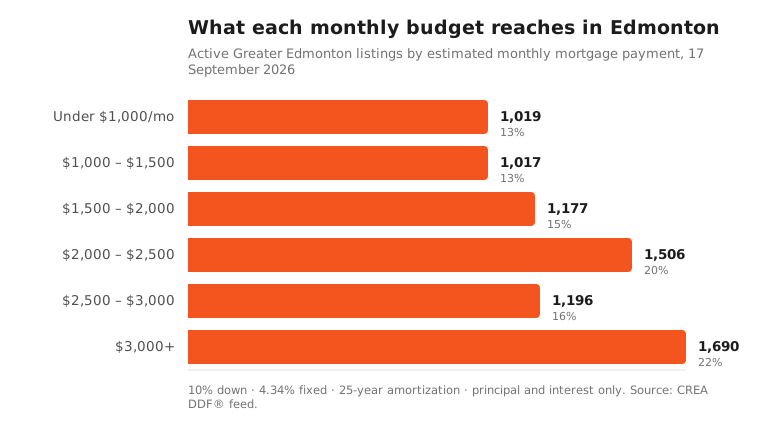
As of 17 September 2026, there were 7,605 active listings across Greater Edmonton in Padster’s CREA DDF® feed, with a median list price of $449,900. At 10% down, 4.34% fixed over 25 years, that median works out to roughly $2,214 a month in principal and interest.
Here is what different rents reach, using those same assumptions. Read this as a map of the market, not a statement about what you personally qualify for.
| If your housing budget is | Approximate list price | Listings within reach | Share of the market |
|---|---|---|---|
| $1,500 / month | up to about $305,000 | 2,036 | 27% |
| $2,000 / month | up to about $406,000 | 3,213 | 42% |
| $2,500 / month | up to about $508,000 | 4,719 | 62% |
Assumptions: 10% down payment, 4.34% fixed interest, 25-year amortization, principal and interest only. Excludes property taxes, condo fees, home insurance, mortgage default insurance, utilities and maintenance. Illustrative only — confirm the numbers for your own circumstances with a licensed mortgage professional.
At the $2,000 level, the 3,213 listings within reach included 431 one-bedroom, 1,400 two-bedroom, 1,045 three-bedroom and 251 four-bedroom homes. In other words, a $2,000 monthly budget in Edmonton is not confined to small condos — which is exactly the kind of thing worth knowing before you decide the answer is no.
The complete monthly cost, line by line
Below is the structure to fill in for any home you are seriously considering. The mortgage payment is usually the largest line, and almost never the whole story.
| Cost | Applies to | Notes |
|---|---|---|
| Mortgage principal & interest | All | The figure Padster shows on every listing |
| Property taxes | All | Billed by the City of Edmonton; often paid monthly with the mortgage |
| Condo fees | Condos, many townhouses | Ask what they include — heat and water sometimes are |
| Home insurance | All | Required by your lender |
| Mortgage default insurance | Under 20% down | Usually added to the mortgage rather than paid monthly |
| Utilities | All | Often higher in a house than the apartment you are leaving |
| Maintenance & repairs | All | The line renters have never had to carry |
Maintenance is the one former renters most reliably underestimate, because a landlord has always absorbed it. Setting aside a monthly amount from your first month of ownership is a habit worth starting before the first repair arrives rather than after.
Questions worth asking yourself
- If my monthly housing cost rose by $300, would that be uncomfortable or genuinely unmanageable?
- Do I expect to stay in this home long enough for the buying and selling costs to make sense?
- Is my down payment traceable, and has it been in my account long enough for a lender to accept it?
- Have I checked my credit report myself, or am I assuming?
- Do I have anything left over after closing, or does this purchase use every dollar I have?
- Am I comparing my rent to a mortgage payment, or to the complete cost of ownership?
Common mistakes to avoid
Treating maximum approval as a budget
A lender tells you the most they will lend. That number is an upper bound, not a recommendation. The comfortable number is usually lower, and only you can identify it.
Comparing rent to the mortgage payment alone
If your rent is $1,800 and a listing shows $1,800 a month, those are not equivalent. Add taxes, insurance, utilities and maintenance before drawing any conclusion.
Making a major purchase between pre-approval and possession
Financing a vehicle or opening new credit after pre-approval can change your debt ratios enough to affect final approval. Step 4 covers this in detail — it is one of the most common preventable problems in the whole process.
Spending every dollar on the down payment
Closing costs are real, and the first months of ownership tend to produce expenses. Arriving at possession day with nothing in reserve is a stressful way to begin.
Comparing rent to a mortgage payment alone? That is the single most common way buyers underestimate ownership. Use the table above, then see how Padster calculates its estimates.
Your next practical steps
- Write down your complete current housing cost. Rent, tenant insurance, utilities, parking, storage. This is your real comparison baseline.
- Check your credit report. Do this before anything else, because errors take the longest to fix.
- Total your available savings and separate what is genuinely for a down payment from what needs to stay as an emergency fund.
- Open an FHSA if you qualify, even with a small initial contribution — contribution room begins when the account is opened.
- Estimate your complete monthly budget using the table above, not the mortgage payment alone.
- Talk to a licensed mortgage professional about pre-qualification. This costs nothing and replaces guesswork with a real range.
- Browse by monthly payment to see what your range actually reaches in Edmonton today.

Ryan McCann
Ryan is an Edmonton-based REALTOR® with MaxWell Polaris and the person behind Padster. He's helped over 2,200 clients in the Edmonton area buy and sell their home.
Contact Ryan today at 780-964-8445 to talk through your next step.
Last reviewed 11 August 2026. General information for Edmonton-area buyers — not individualized financial, mortgage, legal or tax advice. Mortgage rules, government programs and market figures change; confirm current details with a licensed mortgage professional, an Alberta real-estate lawyer, or the relevant government source before making a decision. Padster is not a brokerage.
Sources
- Financial Consumer Agency of Canada — How much you need for a down payment
- Department of Finance Canada — Higher down payments for more expensive homes (the $1.5 million insured cap, effective 15 December 2024)
- Office of the Superintendent of Financial Institutions — Minimum qualifying rate for uninsured mortgages
- Canada Revenue Agency — First Home Savings Account (FHSA)
- Canada Revenue Agency — The Home Buyers' Plan
- CMHC — General requirements to qualify for homeowner mortgage loan insurance
- Government of Alberta — Land Titles and Surveys common document fee schedule
- Edmonton listing figures: Padster’s CREA DDF® feed, active Greater Edmonton listings, pulled 17 September 2026
Last reviewed 12 August 2026.
Your next step
See what your current rent could buy
Type what you pay each month and Padster will show you every Edmonton-area home whose estimated mortgage payment lands under it — so you can compare the market against a number you already know.
Browse Edmonton homes by monthly paymentFrequently asked questions
How much do I need saved to buy a home in Edmonton?
Plan for the minimum down payment plus closing costs. The minimum is 5% on the portion of the price up to $500,000 and 10% on the portion between $500,000 and $1.5 million — so $20,000 on a $400,000 home. Closing costs in Alberta are comparatively low because there is no provincial land transfer tax, but budget for legal fees, an inspection, and Land Titles registration fees of $50 plus $5 per $5,000 of value on both the transfer and the mortgage.
Does my rent tell me what mortgage I can afford?
It is a useful starting point for comparison, not a qualification test. Rent demonstrates what you have paid consistently, which lenders do find informative. It does not account for property taxes, condo fees, insurance, maintenance, or the stress test, which requires qualifying at the greater of your contract rate plus 2% or 5.25%.
What credit score do I need to buy a house in Canada?
For an insured mortgage, CMHC requires a minimum credit score of 600 for at least one borrower, though lenders often look for more. Your score is one factor among several, alongside income stability, existing debt payments, and the source of your down payment.
Is Alberta's lack of land transfer tax actually a meaningful saving?
Yes. Alberta charges Land Titles registration fees instead. On a $400,000 purchase with a $380,000 mortgage, those fees total roughly $880 — compared with several thousand dollars of land transfer tax in some other provinces. The levy did increase on 20 October 2024, so older articles may understate it.
Should I get pre-approved before I start looking?
Generally yes, before you shop seriously. Pre-approval tells you the range a lender will work with and helps separate maximum approval from a comfortable budget. It is not a guarantee of final approval, which depends on the specific property and updated verification at the time of purchase.
How long does my income need to be stable?
Lenders want consistent, documentable income. Salaried employment past probation is straightforward; self-employment, commission and contract income typically require about two years of filed returns. If a job change is coming, discuss the timing with a mortgage professional before making an offer.
Can I use both an FHSA and the Home Buyers' Plan?
Yes. The CRA permits a qualifying FHSA withdrawal and an RRSP Home Buyers' Plan withdrawal for the same qualifying home, provided you meet the conditions for each at the time of each withdrawal. The FHSA allows $8,000 per year to a $40,000 lifetime maximum; the Home Buyers' Plan limit is $60,000.