How to Search for a Home in Edmonton Without Wasting Six Months

Most people who spend six months looking for a home did not spend six months looking. They spent two weeks looking, four months waiting to feel certain, and six weekends viewing houses that were never going to work. The search itself is rarely the slow part — the deciding is.
The short answer
Write down your requirements before you look, separated into what a home must have and what you would like. Search on the must-haves only, because every filter you add shrinks the pool faster than you expect. Then view enough homes in your first two weeks to calibrate what your budget really buys, and judge the rest against that.
Key takeaways
- Filters compound. Four reasonable requirements take Greater Edmonton from thousands of listings to a few hundred — see the chart below.
- Separate must-haves from nice-to-haves in writing, before you look. Anything you can change after possession is a preference, not a requirement.
- Location, floor plan, light and noise cannot be renovated. Kitchens, flooring, paint and fixtures can. Weight them accordingly.
- View six to ten homes in your first fortnight. Fewer and you have no calibration; far more and every home starts to blur.
- Photographs reliably mislead on three things: room size, noise, and what the property backs onto. Check all three in person.
Who this guide is for
Edmonton-area buyers with a budget and, ideally, a pre-approval, who are about to start viewing and want to reach a decision without burning a season on it.
Every filter costs you more than you think
Requirements feel additive. They are multiplicative. Here is what happens to the Greater Edmonton pool as four ordinary requirements are applied one after another.
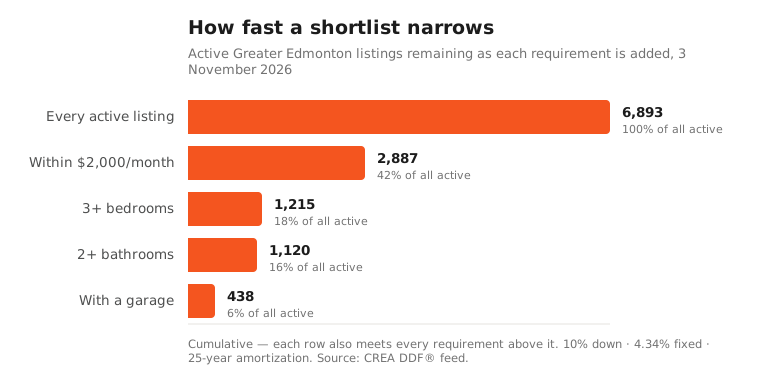
None of those four requirements is unreasonable. Together they leave a small fraction of the market. That is not a reason to abandon your requirements — it is a reason to know which ones you are prepared to trade, before a specific house forces the question at speed.
Start from a budget and narrow from there:
If your must-have list leaves you under about twenty active listings, it is a wish list rather than a search. Decide which single requirement to relax now, calmly, rather than in the moment when a house you like fails on it.
Write the two lists first
Before you look at a single listing, write down two columns.
Must have — the things that would make you decline an otherwise perfect home. Commute time, bedroom count, a yard for the dog, single-level living, a school catchment. Keep this list short. Five is plenty; three is better.
Would like — everything else. An ensuite, a garage, a finished basement, a particular kitchen.
The test for which column something belongs in: can it be changed after possession? A kitchen can. A location cannot. A basement can be finished; a lot cannot be made quieter.
Search on payment, not price
A price band is an awkward proxy for what you can afford, because two homes at the same price can carry very different monthly costs once condo fees and taxes are counted. Searching by monthly payment keeps the comparison honest, and it is how this site is built.
Set the ceiling at your comfortable number from step 2 rather than your pre-approval maximum. Listings above it are not opportunities; they are distractions that make everything affordable look disappointing.
Calibrate early, then move
Your first few viewings are not really about buying. They are about learning what your budget buys in your chosen areas, which no amount of browsing achieves. Photographs flatten rooms, hide noise and omit what the property backs onto.
Aim for six to ten homes in the first fortnight, across the range of what you are considering — including one or two you expect to dislike, which is often where the useful information is. After that, you will recognise a good one quickly, and be able to act on it.
What to check in person, every time
- Noise — traffic, rail, flight paths, and the neighbours. Stand still and listen for a full minute.
- What it backs onto — a park and a parking lot photograph identically from inside.
- Light — which way the main windows face, and what that means in a Edmonton January afternoon.
- Water — staining at the base of basement walls, around windows, and under sinks.
- Age of the expensive things — roof, furnace, hot water tank, windows. Ask outright.
- The commute — drive it once at the time you would actually be driving it.
Keep a short, honest record
After the fourth viewing, homes blur. Note three things per property while you are standing outside it: what you liked, what you would have to fix, and the one thing that would stop you. Read them back at the end of the week.
Patterns show up fast. People who thought they needed four bedrooms often discover they need one more bathroom; people set on a particular area often find the adjacent one delivers the same thing for less.
When to stop looking
There is no perfect home, and the search for one is what turns two months into eight. A sound decision usually looks like this: it meets every must-have, you can afford it comfortably, and nothing about it worries you that a professional inspection would not settle.
If a home clears that bar and you find yourself waiting to see whether something better appears, you are no longer searching — you are deferring. In a market where good listings move quickly, that has a real cost.

Ryan McCann
Ryan is an Edmonton-based REALTOR® with MaxWell Polaris and the person behind Padster. He's helped over 2,200 clients in the Edmonton area buy and sell their home.
Contact Ryan today at 780-964-8445 to talk through your next step.
Last reviewed 12 August 2026. General information for Edmonton-area buyers — not individualized financial, mortgage, legal or tax advice. Mortgage rules, government programs and market figures change; confirm current details with a licensed mortgage professional, an Alberta real-estate lawyer, or the relevant government source before making a decision. Padster is not a brokerage.
Sources
- Canadian Real Estate Association — Canadian Real Estate Association
- CMHC — Information for consumers
- Financial Consumer Agency of Canada — Buying a home
- Listing counts derived from the CREA DDF® feed for Greater Edmonton, refreshed with this site.
Your next step
Search by what it costs you each month
Filter Greater Edmonton by monthly payment, bedrooms and features, and see exactly how many homes still match as you add each requirement.
Open the Edmonton map searchFrequently asked questions
How many homes should I view before making an offer?
There is no correct number, but six to ten in your first fortnight gives most buyers enough calibration to recognise a good fit. Some buy the first home they see and are right to; the point of viewing several is to know that you are right.
Should I look at homes above my budget?
It is usually counter-productive. Viewing above your range recalibrates your expectations upward and makes affordable homes feel like compromises. Search to your comfortable monthly number, not your approval maximum.
How do I know if a neighbourhood is right for me?
Visit at different times — a weekday evening and a weekend morning tell you more than a Saturday afternoon viewing. Drive the commute at the hour you would actually drive it, and walk the block.
Is it worth viewing a home that has been listed for a long time?
Often yes. Time on market frequently reflects pricing or presentation rather than a defect, and those listings can involve less competition. Ask why it has not sold, and let the inspection answer the rest.
What should I bring to a viewing?
Your must-have list, a way to take notes and photographs, and a tape measure if furniture fit matters. Checking your list rather than your impression is what keeps the fourth viewing from overwriting the second.
Can I see how many listings match my requirements before viewing?
Yes — that is what a map search is for, and it is worth doing before you commit to a requirement. If a filter takes you from two hundred matches to eleven, you have learned something important about that requirement's cost.