Condo, Townhouse, Duplex or Detached: Which First Home Is Right?
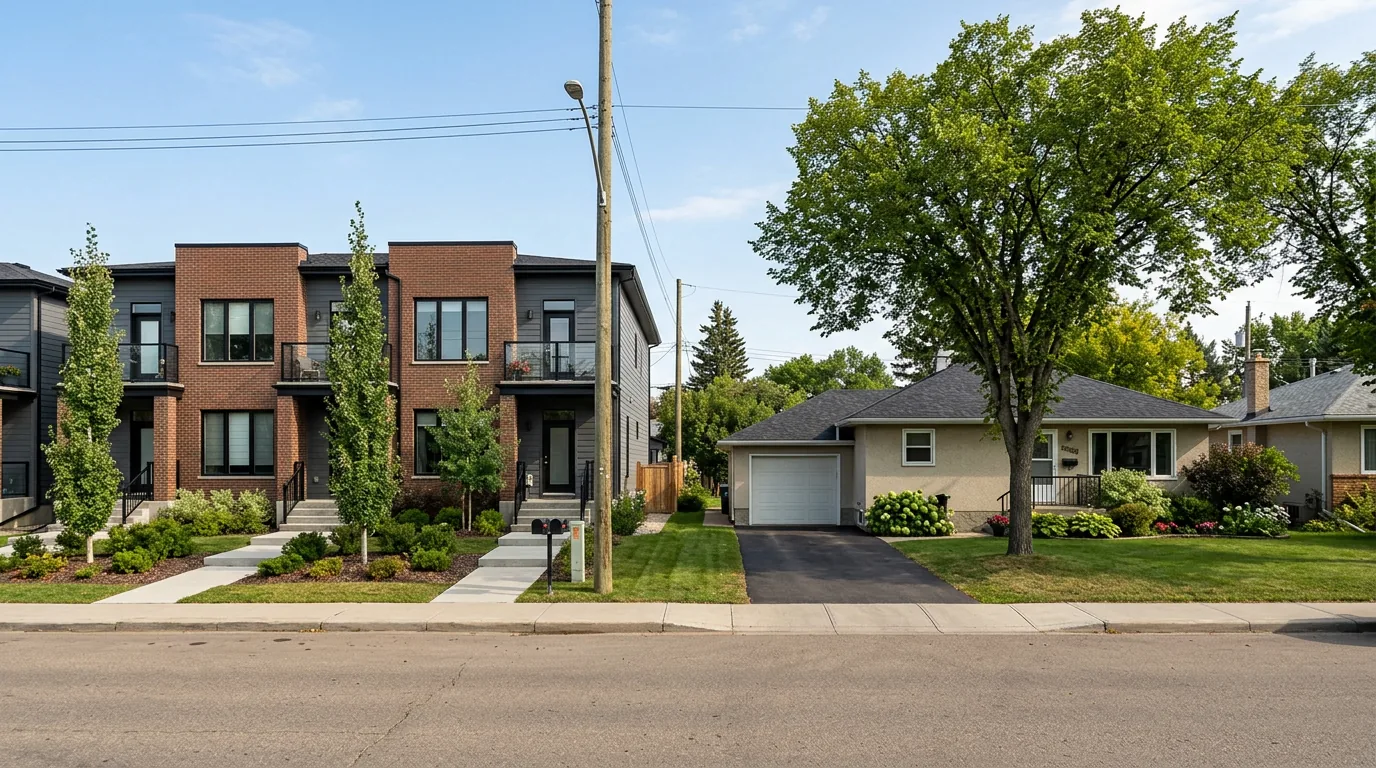
By this point you have a budget and, if you followed step 4, a pre-approval. The next question is the one that actually decides what your days look like: not how much, but what kind. In Edmonton the same monthly payment buys a downtown apartment, a townhouse in the south, or a half duplex on the edge of the city — and those are three quite different lives.
The short answer
Condos cost the least to buy and the most to hold, because condo fees never stop. Detached houses cost the most to buy, carry no fees, and hand you every repair. Townhouses and duplexes sit between the two on both counts. Choose by the total monthly cost and the maintenance you are willing to do — not by the purchase price alone.
Key takeaways
- Purchase price is only half the comparison. At our stated assumptions a condo fee of $400 a month costs the same each month as roughly $73,000 of additional mortgage — it belongs in the maths from the start.
- In Greater Edmonton the median apartment condo and the median detached house are separated by a wide monthly gap. The chart below shows the current spread from our live feed.
- Condo fees are not a fee for nothing. They cover the building envelope, insurance, and the reserve fund — costs a house owner pays too, just unevenly and on their own schedule.
- Ask for the reserve fund study and the last two years of minutes before you buy any condo. It is the single most informative document in the transaction.
- Resale liquidity differs by type. Detached homes in established areas typically draw the widest buyer pool; specialised units draw the narrowest.
Who this guide is for
Edmonton-area buyers who know roughly what they can spend and are deciding between property types for a first home. The condo rules referenced are Alberta's; the market figures are Greater Edmonton and refresh with our listing feed.
What each type costs right now
Rather than describe the gap in the abstract, here it is from the current feed — the median active listing in each type, expressed as the monthly mortgage payment it implies.
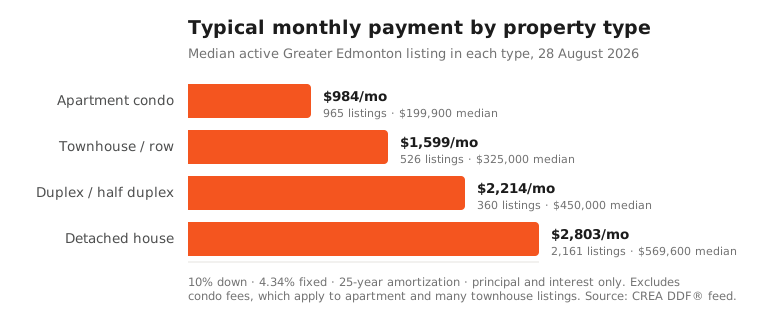
Read that chart carefully, because it flatters condos. The bars are mortgage payments alone. Add a typical apartment condo fee and the real monthly gap between an apartment and a townhouse narrows considerably — sometimes to nothing.
Apartment condos
The lowest entry price in the city, and for a single buyer or a couple without children it is often the only way into ownership near the core. You get no exterior maintenance, no snow to clear, and usually secure parking.
What you take on is a monthly fee you do not control and cannot opt out of. It is set by the condo board, it rises over time, and it can be supplemented by a special assessment if the reserve fund cannot cover a major repair — a new roof, new windows, a parkade membrane. That is the risk that catches first-time condo buyers.
A condo fee is not wasted money — a house owner pays for roofs and insurance too. The difference is that the condo owner pays steadily and by committee, while the house owner pays suddenly and alone. Neither is free.
Best for: buyers prioritising location and low effort over space, who intend to stay long enough to ride out the market, and who will actually read the condo documents.
Townhouses and row housing
Usually multi-level, usually with a small yard or patio, almost always part of a condo corporation — which means fees, though typically lower than an apartment's because there is less shared structure.
The trade is space for stairs and shared walls. For a household that wants three bedrooms without a detached price, this is the middle ground Edmonton has the most of after houses.
Best for: households needing bedroom count more than land, comfortable with some shared governance.
Duplexes and half duplexes
You own your half outright, including the land, and in many cases there is no condo corporation at all — worth confirming, because some are titled as condos and do carry fees. One shared wall, a private yard, a driveway.
The considerations are the shared wall itself (sound transmission varies enormously with construction era) and, where there is no corporation, agreeing with your neighbour on shared-element repairs. Get that in writing where you can.
Best for: buyers who want land and autonomy without a fully detached price.
Detached houses
No shared walls, no fees, no board. Every decision and every repair is yours. Edmonton has a great deal of detached stock, and outside the core it remains reachable on a middle income — which is not true in most large Canadian cities.
Budget for maintenance properly. A common planning figure is 1% of the home's value per year, averaged over the long run. Some years are nil; the year the furnace and the shingles go together is not.
If the total monthly cost of a detached house and a condo come out close, look at the age and condition of both. A newer condo with a healthy reserve fund and an older house with an ageing roof are not the same risk, whatever the listing price says.
Best for: households wanting space, privacy and control, with the cash reserve and inclination to handle upkeep.
The comparison that actually matters
Compare total monthly cost, not purchase price. For each candidate, add up:
- The mortgage payment at your real rate
- Property taxes, divided by twelve
- Condo fees, where they apply
- Insurance — condo insurance is cheaper than house insurance, since the corporation insures the structure
- A maintenance allowance — larger for a detached house, smaller but not zero for a condo
- Utilities you would pay yourself, which vary a lot between an apartment and a house
Do this for one of each type in your range. The ranking often reverses against the one the sticker prices suggested.
Before you commit to any condo
- The reserve fund study — what major work is coming, and whether the fund covers it.
- Two years of board minutes — where you learn about the leak nobody advertises.
- The budget and fee history — steady increases are healthy; a flat fee for a decade often is not.
- Bylaws — pets, rentals, smoking, and what you may change in your own unit.
- Any special assessment levied or contemplated.
In Alberta these documents are obtainable before your condition deadline. An offer that does not allow time to read them is an offer worth rewriting.

Ryan McCann
Ryan is an Edmonton-based REALTOR® with MaxWell Polaris and the person behind Padster. He's helped over 2,200 clients in the Edmonton area buy and sell their home.
Contact Ryan today at 780-964-8445 to talk through your next step.
Last reviewed 12 August 2026. General information for Edmonton-area buyers — not individualized financial, mortgage, legal or tax advice. Mortgage rules, government programs and market figures change; confirm current details with a licensed mortgage professional, an Alberta real-estate lawyer, or the relevant government source before making a decision. Padster is not a brokerage.
Sources
- CMHC — Information for consumers
- Financial Consumer Agency of Canada — Buying a home
- Property type medians derived from the CREA DDF® feed for Greater Edmonton, refreshed with this site.
Your next step
Compare the types by what they cost each month
Padster prices every Edmonton listing by its estimated monthly payment, so a condo and a house can be compared on the number that actually matters.
Browse Edmonton homes by monthly paymentFrequently asked questions
Are condo fees negotiable?
No. They are set by the condo corporation's budget and divided among owners according to unit factors registered on title. You can review the budget before buying, but you cannot negotiate your share.
What is a special assessment?
A one-time charge levied on owners when the reserve fund cannot cover necessary repairs. It can run to thousands of dollars per unit, which is why the reserve fund study matters more than any other condo document.
Is a duplex always cheaper than a detached house?
Usually, though not always — a newer duplex in a desirable area can exceed an older detached house further out. Compare specific properties rather than categories.
Do townhouses always have condo fees?
Most do, because the land and exterior are commonly held. Some are titled as bare land condominiums with much lower fees, and a few freehold row houses have none at all. Confirm on the specific listing.
Which property type holds its value best in Edmonton?
No type is guaranteed to outperform. Historically, properties with the widest buyer pool — well-located detached homes and townhouses in established areas — tend to be the most liquid when it is time to sell. Location and condition usually matter more than type.
Can I get a mortgage on any condo?
Not automatically. Lenders assess the corporation as well as the buyer, and may decline buildings with litigation, low reserves or a high proportion of rentals. Tell your mortgage professional the specific building early.