Rent or Buy in Edmonton: At What Rent Does Buying Make Sense?
The rent-or-buy question is usually argued in the abstract and decided in the specific. The honest version is not "is buying better?" but "at your rent, in this city, with your circumstances, what would the two actually cost you each month — and how long would you stay?"
The short answer
Buying tends to make sense when you will stay long enough to absorb the transaction costs — commonly reckoned at several years — and when the total monthly cost of owning is close enough to your rent that the difference is worth what you get. In Edmonton those conditions are met more often than in most large Canadian cities, because prices are lower relative to income and there is no provincial land transfer tax.
Key takeaways
- Compare total monthly cost against rent, not mortgage payment against rent. The mortgage is roughly 75–85% of what ownership costs.
- Time horizon is the single biggest factor. Buying and selling both cost money; a short stay rarely recovers it.
- Renting is not throwing money away. It buys flexibility, a capped monthly cost, and somebody else's responsibility for the roof.
- The chart below converts a monthly payment into the purchase price it supports, which is the arithmetic most rent-versus-buy debates skip.
- Your down payment's alternative use matters. Money in a home is not available for anything else.
Who this guide is for
Edmonton-area renters weighing whether to buy in the next year or two. The programs mentioned are federal; the market figures are Greater Edmonton and refresh with our listing feed.
What your rent would buy
Start with the direct translation. Hold a monthly payment fixed and solve for the price it supports, then count how many Edmonton homes sit at or below it.
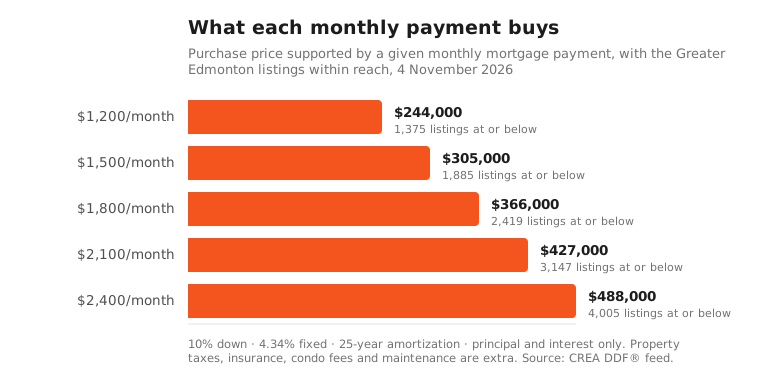
Two cautions. These are mortgage payments alone, so a like-for-like comparison with rent needs the ownership costs added. And the counts include every property type — some of those listings are apartment condos carrying a monthly fee on top.
Jump straight to what each band currently reaches:
What ownership adds to the payment
Rent is close to a complete number. Ownership is not. On top of principal and interest:
- Property taxes — a meaningful monthly amount in Edmonton, billed annually or through your lender.
- Home insurance — more than tenant insurance, because you now insure the building.
- Condo fees, where they apply.
- Maintenance — commonly planned at around 1% of value per year, lumpy in practice.
- Utilities your landlord may currently cover — often heat and water.
Together these typically add 15–25% on top of the mortgage payment. A $1,800 mortgage payment is realistically a $2,100–$2,250 monthly commitment.
Do the comparison in one direction only: total cost of owning against total cost of renting, both including insurance and utilities. Mixing a full rent figure against a bare mortgage payment is the most common way this decision gets made on bad arithmetic.
The transaction costs nobody budgets for
Buying costs money beyond the down payment: legal fees, the inspection, land titles registration, and moving. Selling costs more, principally commission. Those costs are why time horizon dominates the decision — they are paid once, and a short stay gives you little time to absorb them.
Alberta helps here. With no provincial land transfer tax, the entry cost is materially lower than in Ontario or British Columbia, where that tax alone runs to thousands.
When renting is the better decision
It genuinely often is. Rent if you may move within a couple of years, if your work or relationships are unsettled, if your income is irregular in a way lenders will penalise, or if buying would leave you with no financial cushion at all.
Renting also caps your exposure. Your landlord pays when the furnace fails. That is worth something, and it is worth more when your savings are thin.
When buying tends to win
- You expect to stay several years or more.
- Your total monthly ownership cost is within reach of your rent.
- You have the down payment and the closing costs and a reserve left over.
- Your income is stable and documentable.
- You want to make changes to where you live, and control what happens to it.
Note what is not on that list: a prediction about prices. Nobody reliably knows, and a decision that only works if the market rises is not a plan.
How to settle it for your own situation
Take your current all-in housing cost. Take a specific listing you would actually buy and total its real monthly cost. Compare them, then ask how confident you are about staying five years. That is the decision — not the general argument.
If you want the first half done for you, our step 2 guide walks the budget arithmetic from your rent, and every listing here is priced by its estimated monthly payment.

Ryan McCann
Ryan is an Edmonton-based REALTOR® with MaxWell Polaris and the person behind Padster. He's helped over 2,200 clients in the Edmonton area buy and sell their home.
Contact Ryan today at 780-964-8445 to talk through your next step.
Last reviewed 12 August 2026. General information for Edmonton-area buyers — not individualized financial, mortgage, legal or tax advice. Mortgage rules, government programs and market figures change; confirm current details with a licensed mortgage professional, an Alberta real-estate lawyer, or the relevant government source before making a decision. Padster is not a brokerage.
Sources
- Financial Consumer Agency of Canada — Buying a home
- CMHC — Information for consumers
- Alberta Land Titles — Land Titles
- Listing prices and counts derived from the CREA DDF® feed for Greater Edmonton, refreshed with this site.
Your next step
See what your rent would own
Type what you pay in rent and see the Edmonton homes whose estimated monthly payment matches it.
Browse Edmonton homes by monthly paymentFrequently asked questions
Is it cheaper to rent or buy in Edmonton?
It depends on the specific home and how long you stay. Edmonton's purchase prices are low relative to most large Canadian cities, so monthly ownership costs are often close to rent — but ownership adds taxes, insurance and maintenance on top of the mortgage payment, and buying and selling both cost money.
How long do I need to stay for buying to make sense?
Long enough to absorb the transaction costs of buying and later selling. Several years is the common rule of thumb. The shorter your expected stay, the stronger the case for renting.
Is renting throwing money away?
No. Rent buys housing, flexibility and a capped monthly cost, and it transfers the risk of major repairs to the landlord. Owning builds equity but carries costs and risks that renting does not.
Does Alberta have a land transfer tax?
No. Alberta charges land titles registration fees instead, which are far smaller — a few hundred dollars on a typical purchase rather than the thousands a land transfer tax would cost.
Should I wait for prices to fall before buying?
Timing the market reliably is not something most buyers manage. A decision that only works if prices move a particular way is fragile. Whether you can comfortably afford the monthly cost, and how long you will stay, are things you can actually assess.
What if I can afford the mortgage but not the extra costs?
Then the honest answer is that you cannot yet afford the home. Taxes, insurance and maintenance are not optional, and a purchase that leaves no reserve for the first significant repair is a fragile position. Step 1 of our series covers what to have in place.