What Income Do You Need to Buy a Home in Edmonton?

"What income do you need to buy a house?" is usually answered with a number somebody worked backwards from a mortgage payment. Lenders do not work that way. They apply two ratios, qualify you at a rate higher than the one you will pay, and count costs that most published figures leave out.
The short answer
Your Gross Debt Service ratio — housing costs as a share of gross income — is capped at 39%, and housing costs include property tax and heat, not just the mortgage. You are qualified at the greater of your contract rate plus 2% or 5.25%. The chart below works the arithmetic backwards to the income each Edmonton price band requires.
Key takeaways
- Housing costs for the ratio include the mortgage payment, property tax, heat, and half of any condo fee — not the mortgage alone.
- You are assessed at the stress-test rate, so the qualifying payment is higher than the payment you would make.
- The second ratio, Total Debt Service, is capped at 44% and includes every other debt you carry.
- Existing debt reduces what you qualify for by more than the payment itself, because it eats ratio room.
- These are ceilings. The income that lets you buy comfortably is usually higher than the income that lets you qualify.
Who this guide is for
Edmonton buyers working out whether their income supports a given price. The ratios are the standard federal ones; individual lender policies vary, and your own assessment is what governs.
The income each price requires
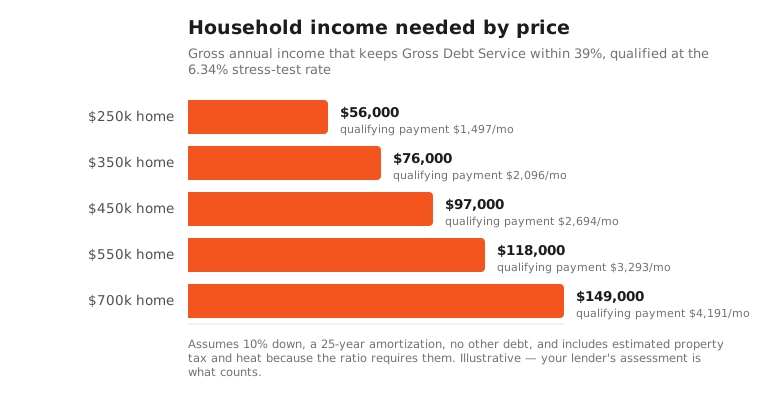
Two things to notice. The qualifying payment shown is higher than the payment you would actually make, because it is calculated at the stress-test rate. And the figures assume no other debt — which is where most real applications differ.
Why other debt costs more than it looks
The Total Debt Service ratio caps housing plus all other debt payments at 44% of gross income. A car payment does not just take its own amount out of your budget — it consumes ratio room that would otherwise support mortgage, and the mortgage it displaces is a multiple of the payment.
This is the arithmetic behind the standard advice not to finance a vehicle while buying a home. It is not caution for its own sake; a modest monthly payment can reduce your approval by tens of thousands.
If you are within a year of buying, clearing a small balance can do more for your approval than saving the same amount toward the down payment. Ask your mortgage professional to run it both ways before deciding where the money goes.
What the ratios do not capture
They are blind to almost everything about your life. Childcare, tuition, supporting family, medical costs, an irregular income, a commute that requires a second vehicle — none of it appears in a GDS calculation.
That is why a lender's maximum is a ceiling rather than a recommendation. Two households with identical incomes can be in entirely different positions at the same purchase price.
If your income does not reach
- Increase the down payment. Less borrowed is a smaller qualifying payment.
- Clear consumer debt first, for the ratio reason above.
- Consider a different property type. Step 5 covers what that trade actually costs — and remember half a condo fee counts against your ratio.
- Look at a longer amortization, which lowers the payment and raises lifetime interest. A real trade-off, not a free one.
- Add a qualified co-applicant, understanding that it is a joint legal obligation, not a favour.
The better question
Not "what is the most I can qualify for?" but "what monthly payment would I be comfortable with if something went wrong?" Work from that number outward — it is what our affordability guide does, starting from what you already pay in rent.
Then get a real pre-approval. A figure from an article is orientation; a lender looking at your actual documents is the answer.

Ryan McCann
Ryan is an Edmonton-based REALTOR® with MaxWell Polaris and the person behind Padster. He's helped over 2,200 clients in the Edmonton area buy and sell their home.
Contact Ryan today at 780-964-8445 to talk through your next step.
Last reviewed 12 August 2026. General information for Edmonton-area buyers — not individualized financial, mortgage, legal or tax advice. Mortgage rules, government programs and market figures change; confirm current details with a licensed mortgage professional, an Alberta real-estate lawyer, or the relevant government source before making a decision. Padster is not a brokerage.
Sources
- CMHC — Calculating GDS / TDS
- Office of the Superintendent of Financial Institutions — Minimum qualifying rate for uninsured mortgages
- Financial Consumer Agency of Canada — Preparing to get a mortgage
Your next step
Start from the payment, not the maximum
Every Greater Edmonton listing here is priced by its estimated monthly payment, so you can shop from a number you are comfortable with.
Browse Edmonton homes by monthly paymentFrequently asked questions
What salary do I need to buy a house in Edmonton?
It depends on the price, your other debts and your down payment. The chart in this article works it backwards from the lender ratios for five price points, assuming 10% down and no other debt. Existing debt raises the income required.
What is the GDS ratio?
Gross Debt Service — your housing costs as a share of gross income, capped at 39% for an insured mortgage. Housing costs include the mortgage payment, property tax, heat, and half of any condo fee.
What is the stress test?
Federally regulated lenders qualify you at the greater of your contract rate plus 2% or 5.25%. Your approval is based on that higher payment, not the one you would actually make.
Does a car loan really affect how much house I can buy?
Substantially. The Total Debt Service ratio caps housing plus all other debt at 44% of gross income, so a vehicle payment consumes ratio room that would otherwise support a mortgage — often reducing your approval by many times the payment itself.
Can two incomes be combined?
Yes, co-applicants' incomes are generally considered together, as are their debts. It is a joint legal obligation for the full amount, which is worth being clear-eyed about before entering one.
Is the maximum I qualify for what I should spend?
No. The ratios do not know about childcare, tuition, medical costs or an irregular income. The maximum is a ceiling; a comfortable budget usually sits below it.