Deposit vs. Down Payment: What Edmonton Buyers Mix Up
Two numbers, similar names, completely different jobs — and the one people have not budgeted for is the one due first.
The short answer
The deposit is money you hand over shortly after your offer is accepted, to show the seller you are serious. The down payment is your equity in the home and is paid at closing through your lawyer. The deposit is not extra money: it counts toward the down payment. The catch is timing — the deposit is due in days, weeks before your lender sends anything anywhere.
Key takeaways
- The deposit comes first, often within a day or two of an accepted offer.
- It is credited toward your down payment, not added on top.
- In Alberta it is normally held in the listing brokerage’s trust account, not by the seller.
- There is no fixed amount. It is negotiated, and a larger one signals a stronger offer.
- If you walk away without a condition protecting you, the deposit is what you are risking.
Who this guide is for
Anyone writing a first offer in Edmonton, and anyone who has worked out their down payment to the dollar and has not yet realised part of it is needed much sooner than possession day.
What the deposit actually does
An offer is a promise. The deposit is the part of the promise with money behind it. It tells a seller that you are prepared to put something at risk to take their home off the market while your conditions are worked through.
That is the whole function. It is not a fee, nobody keeps it for providing a service, and in the ordinary course it comes straight back to you as credit against the purchase price on closing.
Where the money actually sits
In Alberta the deposit is normally paid to the listing brokerage and held in its trust account. It does not go to the seller, and the seller cannot spend it while you are still working through conditions.
That matters more than it sounds. Trust accounts are regulated, and the money is released according to the contract rather than according to whoever is most annoyed. It is also why the cheque is made out to a brokerage rather than to a person.
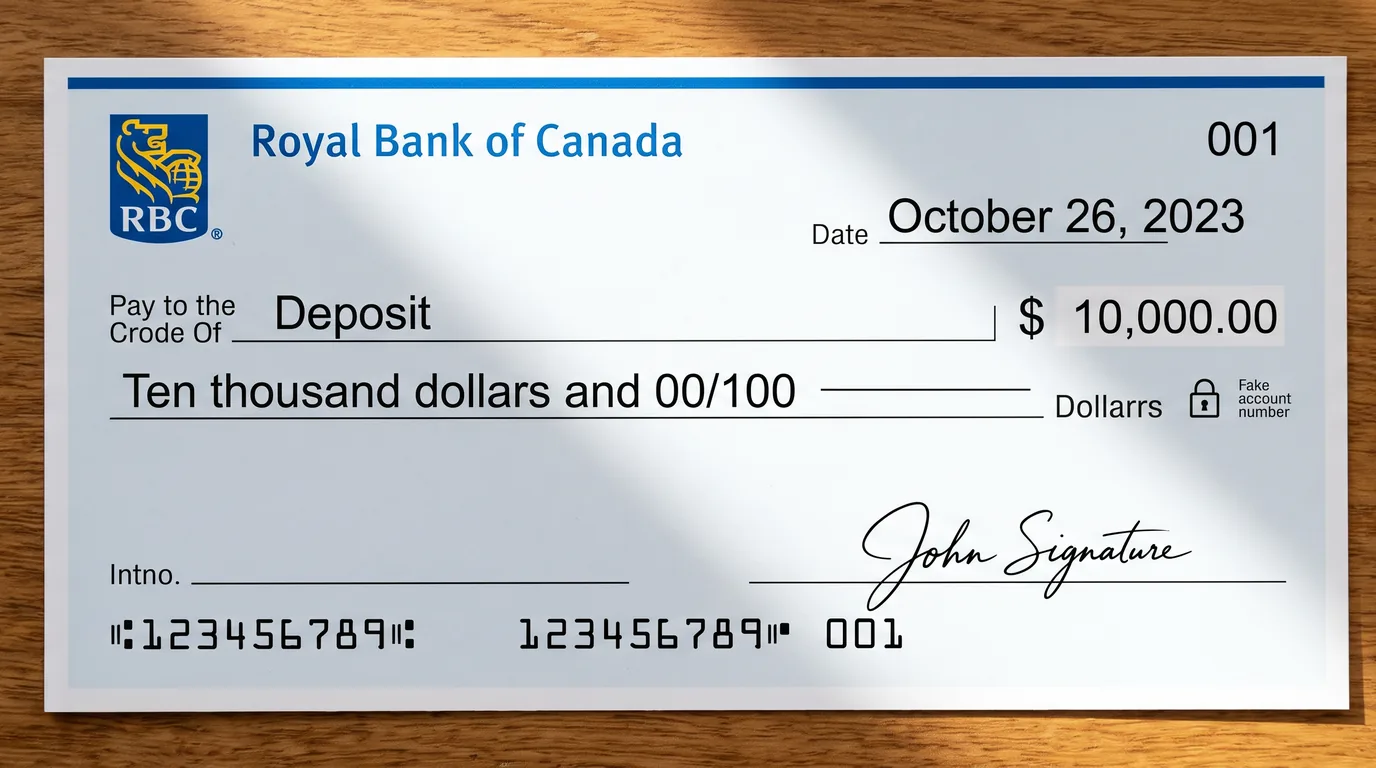
This is one reason a bank draft or certified cheque is usual. It is going into a regulated trust account on a deadline, and a personal cheque that needs to clear does not fit either part of that sentence.
How much is normal in Edmonton?
There is no rule, no percentage set in legislation, and no amount an agent can promise a seller will accept. It is a negotiated term of the offer like price and possession date.
What a deposit signals is seriousness, and in a competing-offer situation a larger deposit is one of the levers a buyer has that costs nothing if the deal completes. What it costs you is liquidity for a few weeks, and exposure if you breach the contract.
- Too small and a seller may read the offer as tentative.
- Too large and you have money tied up, and more at stake if something goes wrong.
- Whatever the figure, it must be money you can actually move on the deadline in the contract.
The timing trap
This is the part that catches first-time buyers. A purchase contract will specify when the deposit is due — often within a very small number of days of acceptance. Your down payment, by contrast, is not needed until closing, which may be a month or two later.
So money sitting in an account you cannot touch quickly is a problem. An FHSA or RRSP withdrawal is not instant. Investments need to be sold and settled. A gift from family needs to arrive, and your lender will want to see where it came from.
Work out where the deposit is coming from BEFORE you write an offer, not after one is accepted. “I have the money, it is just in a GIC” is not the same as having the money on Thursday.
Deposit versus down payment, side by side
- When — deposit: days after acceptance. Down payment: at closing.
- To whom — deposit: the listing brokerage’s trust account. Down payment: your lawyer, who sends it with the mortgage funds.
- How much — deposit: negotiated. Down payment: driven by the lender’s minimum and by what you have.
- Purpose — deposit: showing you are serious. Down payment: your equity in the home.
- Refundable? — deposit: yes if you exit under a condition in the contract; at risk if you simply walk. Down payment: not paid until the deal completes.
Can you lose the deposit?
Yes, and this is the part worth understanding before you sign rather than after. If you exit the deal properly — because a condition in your contract was not satisfied and you said so within the time allowed — the deposit comes back to you.
If you remove your conditions and then decide not to proceed, you are in breach of a binding contract. The deposit is the most visible thing at risk, and it is not necessarily the limit of your exposure. This is exactly why financing and inspection conditions exist and why removing them early to look competitive is a decision with teeth.
Disputes over a deposit are resolved according to the contract and, where the parties cannot agree, through the process the contract and the law provide. Nobody simply keeps it because they are cross.
What this means for your savings plan
Budget in three buckets rather than one, because they come due at three different moments.
- Deposit — needed days after acceptance, in immediately available funds.
- Balance of the down payment — needed at closing, through your lawyer.
- Closing costs — legal fees, adjustments, registration, needed at closing and separate from the down payment.
Our guide to closing costs in Alberta covers the third bucket, which is the one most commonly underestimated after this one.
What happens to it on possession day
On closing, the brokerage releases the deposit and it appears on your lawyer’s statement of adjustments as a credit to you. Your lawyer then collects only the balance — the rest of the down payment plus closing costs — rather than the whole amount again.
This is worth understanding because the statement of adjustments is the first time most buyers see all of it in one place, and a deposit already paid can look like it has vanished if you do not know where to look for it. Ask your lawyer to walk you through the statement line by line; it takes five minutes and it is the clearest picture of the transaction you will get.
Deposits in competing offers
When more than one offer is on the table, the deposit becomes one of the few levers a buyer has that is not price. A seller reading two similar offers will notice which buyer has put more behind theirs.
It is a genuine signal rather than a trick, because it costs the buyer something real: liquidity, and exposure if they breach. That is precisely why it carries weight.
What it should never be is a number you cannot actually deliver on the deadline. An offer accepted on a deposit you cannot fund is worse than an offer that was not accepted.
If you are also selling
Buyers moving from one Edmonton home to another often plan to use proceeds from the sale for the purchase. That works for the down payment. It does not work for the deposit, because the deposit is due long before your sale closes.
So the deposit on the purchase has to come from somewhere else: savings, a line of credit, or bridge financing arranged in advance. This is one of the most common reasons a buyer who is not short of money finds themselves short of money in week one.
If you are selling first, ask your lender about bridge financing at the pre-approval stage rather than at the offer stage. It is much easier to arrange before you need it.
Questions worth asking before you write an offer
- How much deposit is being asked for, and when is it due?
- Which brokerage will hold it, and how do they want it delivered?
- Can I move that money in that timeframe, today, without selling anything?
- Which conditions in this offer protect the deposit, and when do they expire?

Ryan McCann
Ryan is an Edmonton-based REALTOR® with MaxWell Polaris and the person behind Padster. He's helped over 2,200 clients in the Edmonton area buy and sell their home.
Contact Ryan today at 780-964-8445 to talk through your next step.
Last reviewed 24 August 2026. General information for Edmonton-area buyers — not individualized financial, mortgage, legal or tax advice. Mortgage rules, government programs and market figures change; confirm current details with a licensed mortgage professional, an Alberta real-estate lawyer, or the relevant government source before making a decision. Padster is not a brokerage.
Sources
- Government of Alberta — buying a home
- Real Estate Council of Alberta — consumer information
- Financial Consumer Agency of Canada — down payments
Your next step
Get a real number before you need one
A broker who works with Edmonton first-time buyers every day. Free, and no obligation.
Request a free pre-approval introductionFrequently asked questions
Is the deposit part of the down payment?
Yes. It is credited toward your down payment on closing, not charged on top. What differs is timing: the deposit is due days after your offer is accepted, while the rest of the down payment is not needed until possession.
How much deposit do I need in Edmonton?
There is no fixed amount or legislated percentage — it is a negotiated term of the offer. A larger deposit signals a stronger offer, particularly in competition, but it ties up money and increases what is at stake if you breach the contract.
Who holds the deposit in Alberta?
Normally the listing brokerage, in its trust account. It does not go to the seller, and it is released according to the contract rather than at either party’s discretion.
Can I lose my deposit?
If you exit properly under a condition in your contract, within the time allowed, it comes back to you. If you remove conditions and then decline to complete, you are in breach of a binding contract and the deposit is at risk — and it may not be the limit of your exposure.
How do I pay the deposit?
Usually by bank draft or certified cheque, because it is going into a regulated trust account on a short deadline. Confirm the method and the deadline before you write the offer, and make sure the funds are somewhere you can actually move quickly.
What if my down payment is in an FHSA or RRSP?
Then plan the deposit separately. Registered-account withdrawals are not instant, and investments need to be sold and settled. “I have the money” and “I can deliver a draft on Thursday” are different statements.